


The internet and social media's explosive effect on the rise in the sexual exploitation of minors
- Preneil Pillay

- Jul 31, 2023
- 10 min read
The dark side of the internet that we need to talk about more.

Photo by Philipp Katzenberger on Unsplash
“All the processes of the modern world are connected to the Internet and information technologies. But at the same time, when we speak about high-tech processes, "digitalization" - we always know about the main goal: to create safe online environment for our citizens. Therefore, the global initiative to create purposeful cooperation between states, organizations and businesses is extremely relevant”. | H.E. Mykhailo Fedorov
The history of the internet and social media 📡
The internet has been one of the most important innovations of our generation. The internet first launched in January 1, 1983.
The history of the Internet has its origin in information theory and the efforts to build and interconnect computer networks that arose from research and development in the United States and involved international collaboration, particularly with researchers in the United Kingdom and France.
The roots of social media stretch far deeper than you might imagine. Although it seems like a new trend, sites like Facebook are the natural outcome of many centuries of social media development.
The earliest methods of communicating across great distances used written letters. The earliest form of postal service dates back to 550 B.C., and would become more widespread and streamlined in future centuries.
Then, in 1792, the telegraph was invented. This allowed messages to be delivered over a long distance far faster than a horse and rider could carry them. Telegraph messages were short, but were a revolutionary way to convey news and information.
Although no longer popular outside of drive-through banking, the pneumatic post, developed in 1865, created another way for letters to be delivered quickly between recipients. A pneumatic post utilises underground pressurised air tubes to carry capsules from one area to another.
And then, the birth of social media. The first recognisable social media site – in terms of what we consider modern day SM - was Six Degrees. It was created in 1997 and enabled users to upload a profile and make friends with other users. In 1999, the first blogging sites became popular, creating a social media sensation that’s still popular today.
Welcome, Facebook🔖
On February 2004, Facebook entered the fold, which has experienced its own set of privacy and mental health issues as a company, more notably since its seismic growth after acquisitions of companies like Instagram and WhatsApp.
But the infamous #FacebookPapers are a discussion for another day.

Image: Cracked
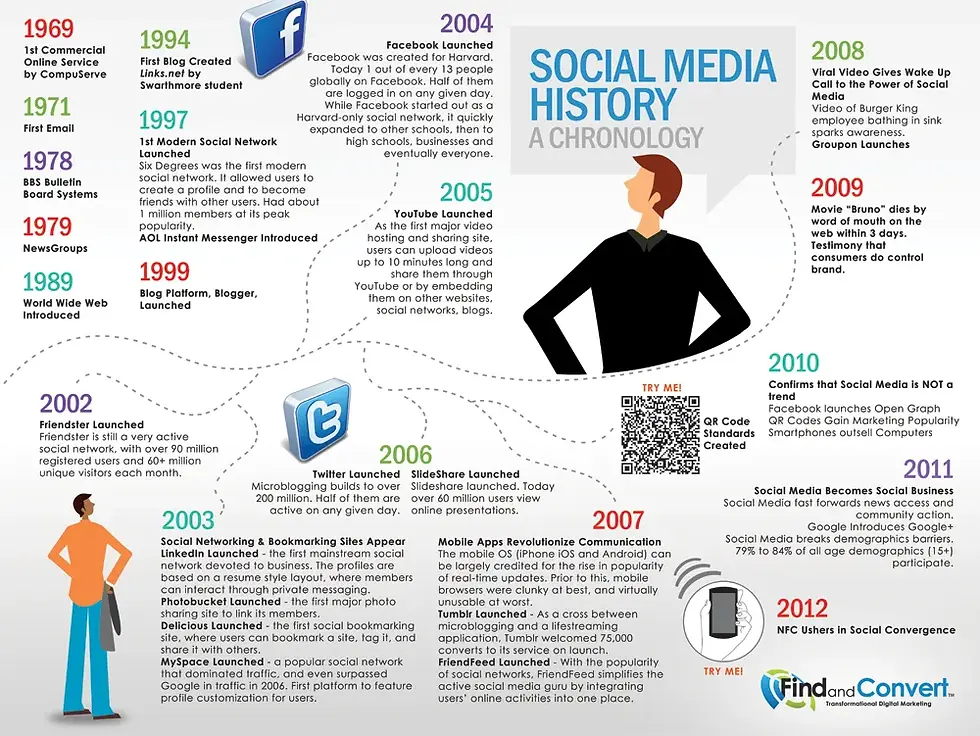
Infographic: Pinterest
Fast forward to 2022, and - like the size of the universe - the exponential growth of social media is unfathomable.
Social media has allowed us to connect with people from all across the world; from the most remote villages to the high-rise metropolitan cities of New York City. Not only has it become a money-making machine, but it’s also become a haven for free speech (but for how much longer?), social activism (Black Lives Matter), content creation, and so much more.
But, unfortunately, it’s also become a haven for activity that often preferred to linger beneath the onioned layers of the Deep, Dark web – until now.
According to CompariTech, in the first three-quarters of 2021, Facebook flagged a staggering 55.6 million pieces of content under “child nudity and sexual exploitation”–20 million more than 2020’s and an overall total of 35.6 million.
According to Facebook’s latest transparency reports, 50 percent of this content (28 million pieces) was flagged in Q2 of 2021 and 41 percent (22.7 million) in Q3 of 2021.

Data unavailable for 2021 for Twitter and Reddit. Facebook, Instagram, and YouTube data for Q1-Q3 of 2021. TikTok, Snapchat, and Discord data for Q1 and Q2 of 2021. Chart: Comparitech
Get the data Created with Datawrapper
Tech giant content removals for child exploitation ✂️
In just nine months of 2021, Facebook had already exceeded 2020’s content removals for child exploitation by a disturbing 20 million. Instagram, TikTok, and Snapchat also exceeded their 2020 figures, with YouTube looking set to do the same, too. These are the platforms that have released reports in 2021.
In the first three-quarters of 2021, the following statistics were released:
Instagram saw 4,797,100 content removals for child nudity and sexual exploitation; 1.5 million more than the entire year of 2020.
Instagram, like Facebook, also saw a sharp rise in Q2 of 2021 with 1.86 million of the year’s content removals coming from April to June. T continued into Q3 with a further 2.1 million removals.
Tiktok also saw a significant increase in Q2 with 33.7 million reports compared to 22.8 million in Q1. This total for the first half of 2021 (56.5 million) outperformed the already-staggering total figure for 55.4 million in 2020.
YouTube saw more content removals in Q1 of 2021 than Q2 and Q3 (5.1 million compared to around 1.9 million in each of Q2 and Q3), but it could still overtake 2020’s total of 11.6 million.
By June 2021, Snapchat had already removed 119,134 accounts for child sexual exploitation and abuse, 20,000 more than 2020’s total of 98,166.
These numbers are staggering and absolutely terrifying for for both parents and non-parents alike.
But why am I talking about this now? 🗣
TikTok user Karla Ramierez’s story struck a nerve.
Ramirez shared that she’s been making sexual content on her OnlyFans account. To those unfamiliar, OnlyFans is a pay-to-view site founded in the UK in 20216 and is for users to post content that they’re able to monetize. In December 2021,the Daily Maverick reported that some South Africans were making up to R16,000 per month. Here’s more information on OnlyFans.
Due to the potential opportunities to make money and the minimal restrictions on adult content, many of its users find it to be an invaluable site for sex work.
But here’s where it gets really dark.
According to her, ‘Your King’ was a knowing customer and personal client of her adult OnlyFans content, and he’d been doing it over a year.
Ramirez was making extra money for herself by posting adult content on the site, but she did not realize that some of that money was coming from her own father.
So how did Ramirez even figure out that it was her dad? This is where it gets even more unreal.
“The only way I found out is because he had called me to ‘play with myself’ for $150 and I could hear my mom in the background talking on the phone.” | Karla Ramirez
He was literally doing this at home whilst his wife and daughter were in the same house. She goes back to address the recent discovery on OnlyFans, saying that these two accounts she believes to be run by her father ‘“have been clients for a very long time”.
Ramirez reveals in the next follow-up TikTok that her father revealed the second account by accidentally sending the money from a separate account to the one she had made an arrangement with.
She has been a victim of sexual abuse since she was around four-years-old and that her father would take her to the houses of friends and girlfriends and “let them touch” her.
I’m going to control my emotions about some of the comments and reactions to her videos, many citing that that’s what she gets for being a “sex worker” – a profession still victimized for the requirements listed in the job spec.
You can read about it here.
So what now? 💭
We’ve seen the numbers above, but what’s the next step here? Where do we go from here? Are there even solutions to this crisis? We’re at a point now where Big Tech is innovating faster than governments are able to draft stringent online safety legislation..
In 2020, Unicef released a research paper titled, “What works to prevent online and offline child sexual exploitation and abuse”, and is a review of national education strategies in East Asia and the Pacific was released.
Let’s bring this closer to home and look at online exposure as a starting point. 🇿🇦
Internet Access (current vs projected) 📈
According to PYGMA, South Africa has one of the highest inequality gaps in the world, but this hasn’t stunted the internet becoming increasingly accessible to all South Africans – with socio-economic status not a factor to accessibility. A 2012 study conducted by the Centre for Justice and Crime Prevention (CJCP), in collaboration with Facebook, found that 19% of internet users in South Africa were living below the poverty line.
A 2016 CJCP report found that nearly half of South Africa’s internet child users were able to access the internet whenever they wanted. The CJCP report also found that:
20,5% of participants aged between 9 and 17 said they had received messages containing X-rated websites ads.
19,2% said they had opened a message, or link in a message, showing pictures of naked people or people having sex.
20,3% said they had seen or received a sexual message, image or video about someone they did want.
46,2% of participants aged between 9 and 11 admitted meeting with a stranger they got to know online face to face, while 41,4 % of participants aged between 12 and 14 admitted doing so.
25,5% of participants aged between 15 and 17 said they were treated in a hurtful or nasty manner online.
In 2021, Statista reported that 60.73 percent of the South African population were internet users; usage is projected to grow to 66.06 percent in 2026.
Image: Microsoft
Online safety and civility🛡
So how did South Africa get here?
If we just look back at the 2019 Microsoft DCI report, it’s an indication of just how much work we still have to do. According to the report, South Africans are among the most at risk for exposure to negative behaviour online. The study gauges the attitudes, behaviours and perceptions of teenagers between 13 and 17 (and adults between 18 and 74), relating to the state of digital civility.
Citing the report:
“The study shows that South African teenage girls suffer more than their global peers, with 68% reporting moderate to severe pain from online risks, while the numbers stand at 61% in the rest of the world.
The study further shows that there is an increase in the numbers of South African teenagers asking for help: 54% said that they would ask a parent for help as opposed to 42% globally, while 37% said they would approach another adult for assistance as opposed to the global average of 28%.
The study found that the level of risk exposure and its consequences was higher for girls than boys. Pain from risks was also stronger and remained longer for girls, and incidents were more emotionally oppressive when compared to boys.”
The study further measures people’s safety online and exposure to risks such as:
cyberbullying
unwanted contact and harassment
exposure to hoaxes and scams
The annual study examines the online behaviour of internet users in 22 countries and in 2019, South Africa ranked 21st out of 22 countries surveyed for exposure to online risks.
In Microsoft’s 2020 Digital Civility Index (DCI), the company found that out of the 32 countries it surveyed, hate speech continued to spread, with nearly four in ten individuals being subjected to cyberbullying incidents.
While most countries on its list hit an all-time worst DCI in 2019, in 2020, only one in four said that online civility was better.
The Netherlands is the country with the most polite netizens, ranking first on Microsoft's list.
The worst in all, was South Africa, which is placed last on its list – a worrying statistic as internet access is predicted to rise - especially since the start of the COVID-19 pandemic.
Current Policy and legislation 🧾
According to PYGMA:
“South Africa has legislation – both pre-existing and proposed – to strengthen online child protection, including the Film and Publications Amendment Act (which, along with further regulating the classification of publications, films and games, it also proposes to regulate prohibited online content, such as child pornography); the Child Justice Act (which protects the rights of children who are accused of, or who have committed, crimes); and the Electronic Communications Transaction Act (which also deals with online privacy and ICT related offences).
The protection of children online also falls under the ambit of various auxiliary laws such as the Criminal Amendment Act, the Protection of Personal Information Act, and the Prevention for Combating of Trafficking in Persons Act.” – (PYGMA)
What can we do to get better and help protect – more specifically - our minors?👶🏼
"It is important to have conversations early and often about how inappropriate content on the Internet may affect children. Parents, educators, guardians and industry all have a part to play in ensuring that children understand how to stay safe online." | Janine Raftopoulos, Former Manager Communications and Public Education of South Africa's Film and Publications Board
Sectors of South Africa’s civil society actively participate in implementing communal online monitoring and advocating for better crime prevention.
They play a critical role in providing in 3 major ways:
online child safety tips
destigmatising cyber-attacks
localising online safety research and education
Civil societies also:
leverage national research for localised solutions.
provide sector-specific training.
promote social justice.
Let’s look at some solutions ✅
To foster a better and safer internet, Microsoft also champions the Digital Civility Challenge, which outlines four major principles that online users can commit to:
Living the “golden rule” – To act with empathy, compassion and kindness in every interaction, and treat everyone online with dignity and respect
Respecting differences – To appreciate cultural differences and honor diverse perspectives, engaging thoughtfully and avoiding name calling and personal attacks
Pausing before replying – To pause and think before responding and not post or send anything that could hurt someone else, damage someone’s reputation, or threaten safety
Standing up for yourself and others – To tell someone when feeling unsafe, offering support to those who are targets of online abuse or cruelty, and report activity that threatens safety
I spent some time looking for a strong list of checkboxes that parents can use to educate their kids on how to identify key markers when it comes to online predators. MediaSmarts has an incredibly strong list, which I have cited below:
Ask young people if they know how to prevent people that they don’t know from contacting them in games, social networks and other online spaces, and how to limit who can see things they post online. If they don’t, suggest learning how, together.
Talk to young people about healthy relationships and the importance of not pressuring people or feeling pressured into doing things they don’t want to do – such as taking explicit pictures of themselves.
Provide kids with safe and reliable sources of information about healthy sexuality. Civil society groups that are active in South Africa include the CJCP, Save the Children SA, Childline, INHOPE, and the NICRO diversion programme.
Tell young people to talk to you if they are being pressured or sexually harassed by anyone. Ask them who they could turn to if they ever felt uncomfortable talking to you about something that happened.
Warn young people that there are people online who target adolescents to engage in sexual conversations. Make sure they understand that this is not limited to people they have met online: people they know offline may try to use digital platforms as a private space for grooming them.
Talk to them about why adults having sex or forming romantic relationships with underage adolescents is wrong. Make sure they understand that online predators are often not “strangers,” but people they already know who will use digital tools to communicate privately with them.
Help them recognise warning signs and grooming tactics, which include:
flattering them, especially about how they look.
asking about times and places where they could meet or communicate online privately.
introducing sex or sexual topics into the conversation.
sharing or offering to share sexual images, either pornography or pictures of the sender.
asking them not to tell their parents or friends about a conversation or about the relationship.
Teach young people “exit strategies” that they can use to get out of online conversations that make them uncomfortable.
Make it clear to them that if they wish to meet a virtual friend in person, it must be in the presence of a trusted adult.
Younger adolescents should share their instant messaging or social networking passwords with their parents. Parent should only access their accounts in the event of a problem.
Help young people who have been victims of online sexual exploitation get counselling about their experience.
If a young person shared a sexual photo or video, consult the tip sheet Help! Someone Shared an Image of Me Without My Consent
![[LISTEN] The rise of sustainable technology and home-based farming](https://static.wixstatic.com/media/b6c14c_614468a14d6f49359c7d07f828faf17b~mv2.png/v1/fill/w_980,h_513,al_c,q_90,usm_0.66_1.00_0.01,enc_avif,quality_auto/b6c14c_614468a14d6f49359c7d07f828faf17b~mv2.png)
![[LISTEN] What is the holistic approach to mental wellness?](https://static.wixstatic.com/media/b6c14c_d7c85354bfc44bceba5d92fa0cec3631~mv2.png/v1/fill/w_980,h_513,al_c,q_90,usm_0.66_1.00_0.01,enc_avif,quality_auto/b6c14c_d7c85354bfc44bceba5d92fa0cec3631~mv2.png)

Comments